
Short Format Video Training
"People learn very little when they’re bored and nothing when they’re asleep"
John Cleese, Actor and Businessman

Driver Training
The current DCPC driver training is loathed by most HGV drivers. And has failed to create the behavioural change required to make the roads safer.
A Practical Approach to Learning
Short Format Video Training offers a much more effective method of conveying important information to the HGV driver community. Chunking down into short format videos could replace much of the current classroom content, making the training more engaging, practical, and relevant to the drivers' daily tasks. And include content such as driver seating posture, nutritional information, tips on better sleep routines and dealing with stressful customer situations.
To address this, a selection of short-format videos could be developed to cover key training topics. These videos would be accompanied by multiple-choice questions to ensure understanding. The completion of these modules could be linked to the Driver Qualification Card (DQC) record, providing an easy way to track a driver’s progress and assess their competency.
By introducing a graduated learning programme with aspirational levels to achieve recognised excellence would revolutionise learning within the HGV driving community.
Moreover, these videos could be made accessible on the job as an aid-memoir, helping drivers refresh their knowledge at the time of use. Sometimes referred to as “Just-In-Time” training.
Practical Training
Where in person training is required it should be done on a practical basis in the yard with equipment.
If we had an effective driver development programme, we could have an agreed industry standard for HGV drivers and Fork Lift Truck (FLT) drivers to work together safely when unloading or loading curtain-siders. The appropriate qualification once passed would be reflected on the DQC carried by the driver. Any organisation that has FLT drivers qualified to the same standard, would know they can work together safely to unload and load curtain siders in a quick, safe and more pleasant way, without having to enter into the demeaning behaviour of asking drivers to stand in painted squares.
Transport and retail sectors may be very different, but people and their basic needs for appreciation are the same.

The Impact of Undiagnosed Neurodiversity
A lack of early diagnosis and support, both in school and later in life, has left many older HGV drivers unaware that they may have dyslexia or other neurodiverse conditions. This gap in recognition has important implications and could help explain why the DCPC training is unpopular among drivers.
Traditional classroom-based training methods are unsuitable for neurodiverse individuals. Many of them have negative memories associated with formal learning environments and, as a result, tend to thrive more in hands-on, interactive learning settings. Practical, real-world training approaches work much better for neurodiverse individuals, allowing them to engage actively with the material.
Dyslexia and other Neurodiversity in the HGV Driving Workforce
Neurodiverse individuals think, process, and act differently compared to those who are neurotypical. This diversity in cognitive processing doesn’t make them better or worse as HGV drivers.
Just different.
Dyslexia affects approximately 8% of the UK population, the prevalence among HGV drivers may be significantly higher. However, no research has ever been conducted to determine the exact proportion of HGV drivers who are dyslexic. Such research would be a good idea. A better understanding of the HGV driver profile would have a very positive impact on many of the problems within the transport sector.
The Role of Working Memory
As an example:
Something referred to as poor working memory, or poor executive function, is a common challenge faced by all neurodiverse individuals. In the context of HGV driving, this issue can manifest in drivers forgetting tasks they’ve started, but not completed. Such as, leaving loading straps on the catwalk, which is a recurring problem, or contributing to debris on the road network, which is a significant risk to road safety.
By acknowledging the specific needs of neurodiverse drivers and teaching them coping strategies, their work experience could be less stressful, more fulfilling, and ultimately safer. In turn, this could lead to a reduction in issues like leaving loading straps on catwalks, reducing road debris, and improving overall road safety. The long-term benefits would include fewer accidents and reduced damage to railway bridges.
I believe that a thorough understanding of neurodiversity and, in particular, the aspects of poor working memory by senior management of the sector, within government, and in large companies, would lead to a significant reduction in bridge strikes!
I have tried to explain this to the railway sector for approximately seven years! My knowledge on this subject has thus far fallen on deaf ears. Clearly, we need to hit more bridges before the lesson is finally learnt!
Ongoing Training That Works For Everybody
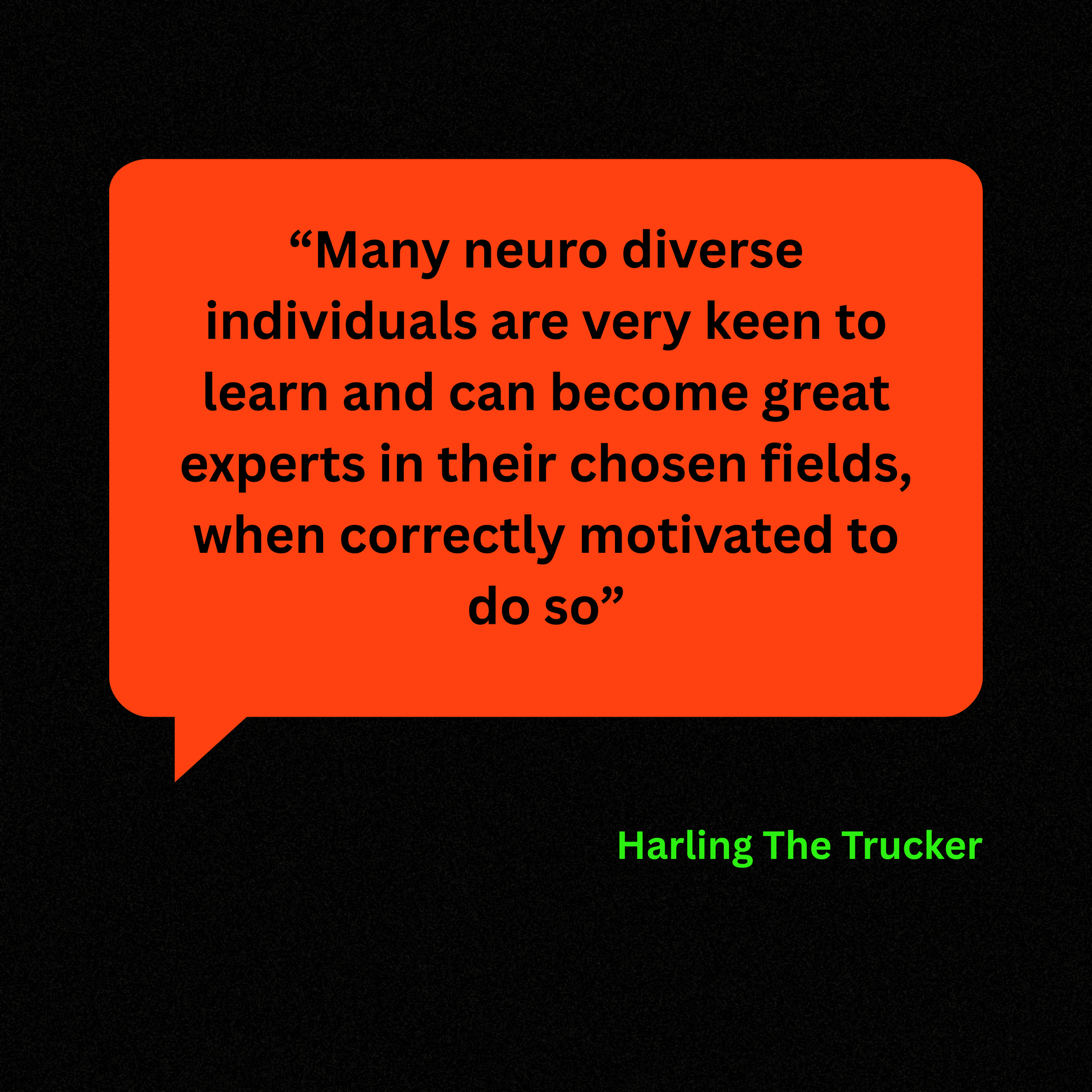
Learning in bite-sized chunks is proven to be more effective for neurodiverse individuals, and this format would also appeal to neurotypical drivers.
Research has shown that teaching strategies tailored for neurodiverse learners work equally well for neurotypical learners.
The Opportunity for National Highways
National Highways is in a unique position to lead the way in recognising the neurodiversity within the HGV driving workforce. By funding research into the specific needs and challenges faced by neurodiverse drivers, they can gain a better understanding of this issue. The knowledge will enable more informed decisions, less straps on the road and lead to better training methods and thus safer roads.
Create World Class HGV Drivers with Aspirational Learning and Elite Driver Status
You can make people sit down in a classroom, but you cannot make them learn. The current ongoing HGV driver training known as DCPC is not fit for purpose and has created such bad feelings within the HGV driver community, I don’t think it can ever be turned into anything worthwhile.
The concept of ongoing training for HGV drivers is an excellent idea. The Driver Qualification Card (DQC) should be kept. But the criteria for gaining the knowledge required to be an excellent and world-class HGV driver needs to be completely rethought, in an innovative way. However, it is possible to get engagement with people by inspiring them to be the best at what they do.
Combine compulsory graduated licences, to educate drivers in the basics of each particular category of vehicle that they are wanting to drive., and then inspire them to be the best at what they do.
Done correctly with the right incentives in place, many HGV drivers will want to learn more and strive to gain “Elite Driver Status.” A voluntary qualification.
The benefit of being recognised as an Elite Driver would be the ability to increase their wages and become desirable to operators who want to be seen to be operating their fleet to a high standard.
I envisage such drivers, as increasing their knowledge for work purposes, would learn life skills of benefit to them in their personal lives. At the top of the list of skills HGV drivers could gain would be that of “Scene of Accident” management, and specific medical skills, to enable them to deal with the kind of trauma they are likely to encounter at the scene of an accident.
As well as the obvious benefits of having capable and trained individuals at the scene of an accident moments after it has happened. It would also reduce the likelihood of witnesses suffering from PTSD.
With further joined up thinking, Elite Drivers could also gain additional discounts on high-quality roadside food encouraging them to eat well.
Training Conclusion
If HGV drivers become better trained, not only in their core job, but also in first-aid and scene of accident management, and viewed as respected eyes and ears on the ground of National Highways, it will attract individuals into the logistics sector that have not previously considered it as a career.
An innovative approach to ongoing training, taking into account understanding of the neurodiversity within the workforce, has the potential to radically change the productivity of the UK HGV workforce. It is an opportunity that could create a world-class HGV workforce that is the envy of the rest of the world. And, a showcase that other countries copy.
In doing so, increase safety and reduce fatalities.